Happy

You can hardly go anywhere these days without hearing the Pharrell Williams song, “Happy.” A report by Carol Graham of the Brookings Institute may indicate that it will not resonate with people uniformly through the life cycle, at least as Brookings Institute report might indicate.

Apparently there is a worldwide trend for people to have a U-shaped pattern to their life-long degree of happiness. Middle age is tough, it seems. Well, middle age can be especially tough. I would not want to minimize, having had my own very low times, how difficult certain seasons and circumstances of life can be. But there is hope to sustain us through those times.

In Romans 15:13 Paul indicates that there is a happiness that does not depend on circumstances.  There is joy, which is not to be taken necessarily  as a jump-up-and-down kind of thing (though it certainly can be), but is based on the certain knowledge that there is the Lord who loves and values us, and has a purpose for us. We know of this, and put it into practice in various ways, through the welcoming of the Holy Spirit.

And, as the context Romans 15:13 makes clear, mutuality of acceptance and service is key to experiencing such enduring inner peace.

 

Bread with a Purpose

The United Nations has just released the second part of a study  on the effects of climate change. It seems, no surprise, it will mean our over-consuming lifestyle is ever more certain to contribute to displacement, hardship and hunger, especially for those least able to deal with such developments. Meanwhile, there has also just been a warning that for some of us our breakfast is going to get more expensive–something a lot of us, if we’re honest–will be more directly concerned about.

This may be impetus for some of us to pray more frequently and fervently for the Lord to give us “our daily bread” (Matthew 6:11). But there is a more complete way to draw on this part of the model prayer Jesus gave, in connection with what comes before that particular part. Before the petition about what we need for each day, there is the invitation to hallow the Lord’s name, welcome the realization of his kingdom, and to look for his will to be done on earth as it is in heaven. Perhaps then, the “daily bread” part that then follows has to do with being nourished and strengthened to have our part in the fulfilling of the previous good things. In so doing, perhaps we will conduct our lives in a more responsible way, one that will help to alleviate, maybe even start to correct, some of the problems of supply in our earthly life that might have led us (back) to prayer in the first place.

Creating Summer, Sort Of

notyetspring


“It was you who set all the boundaries of the earth; you made both summer and winter” (Psalm 74:17 NIV).

It is almost “officially” spring. Today (above photo just taken) there is a mix of freezing rain, snow, and ice pellets. Personally, I find very appealing the proposal, reported today in a Canadian Press article, for a 365 day a year, retractable roof summer theme park for Toronto. If imitation is indeed the sincerest form of flattery, or sincere praise, maybe the Lord wouldn’t mind if we imitate his work just a bit -:)

Nearby Unexplored Universe

There is exciting news for those who like to explore–vicariously at least–parts previously unknown to them. Apparently the big bang theory has been reinforced with a new discovery that is said to give a new window on the beginning of the universe. If you would like a view of something remarkable a little cliser to your space-time locationm there is now available a Street View opportunity to raft the Colorado River through the Grand Canyon.

But if we believe this–“Be devoted to one another in love. Honour one another above yourselves” (Rom. 12:10 NIV)–then there is a universe to be explored that is very close indeed. It is by trying to see the universe around you through the eyes of someone nearby. It is an important and revealing adventure. We just have to ask ourselves  honestly if we really want to see things through someone else’s eyes. But it could be a great personal breakthrough.

How Controlling Are You?

It has been widely reported in the last couple of days that there is now a blood test that can determine if y ou are at risk of developing Alzheimer’s disease. The question is then asked, “Would you want to know?” Setting aside the possibility of false positives, many people apparently would say “yes,” saying it could help them and their loved ones prepare.

It might be worth pondering if you would want to know, even as an exercise in attitude toward how we feel about having control in life.  There is no point in any of us claiming that there is not some degree of control freak in us. On the other hand, I find I enjoy going to meetings more now that I am not in a position to chair them. I think one reason I like public transit is that, if anything is going to go wrong, there is nothing I can do about it anyway, so I just relax.
But knowing with some precision when someone else will have to take charge of my ordinary business of life? I honestly don’t know. But considering the question might be a way for any of us honestly to examine our issues around control in the here and now.

You Are Not Your Own

You are not your own. This can be bad. This can be good. Let’s start with the bad.

We are not our own when we are complacent about government surveillance that gathers all the information about us that it can, just because it might be useful someday. I came across the phrase, “You are not your own” in a piece about “Optic Nerve,” which gathered millions of stills from web cam chats between 2008 and 2010.

And now for the good: “You are not your own; you were bought at a price” (1 Corinthians 6:19-20). The Apostle Paul is talking here about the use of our bodies, but from a broader perspective it is good to know that there is one who already knows all about us, and wants only the best for us.

Surrounding Voices

spadinaandqueen


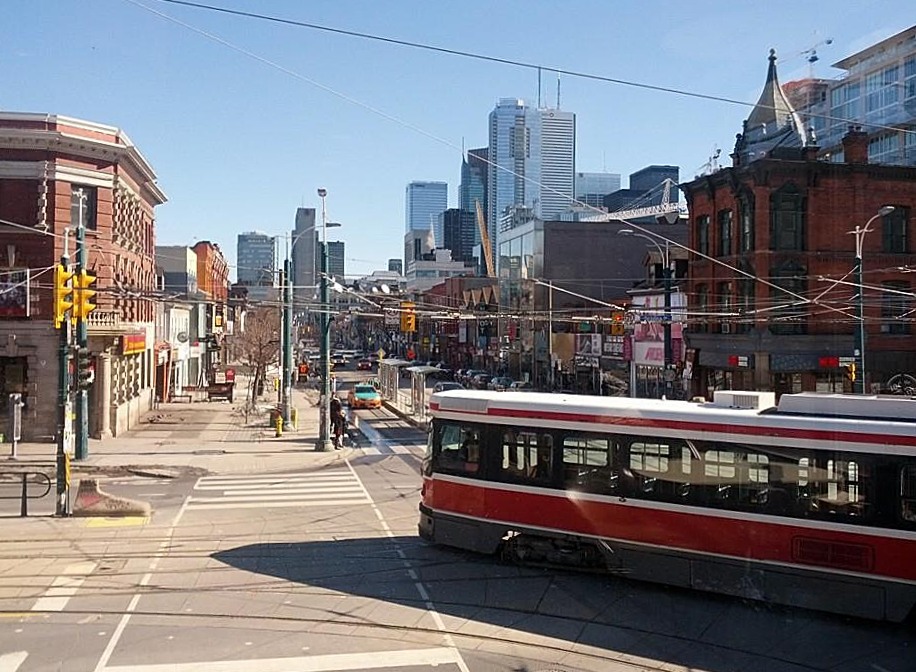
I like public transit. Really. Sure, there’s something about getting in a car and going where you want when you want. But, in addition to environmental concerns, there is something I really like about public transit.

I thought of this once again while having coffee on the upper level of a McDonald’s at Queen and Spadina in Toronto, looking out at the corner (phone photo above), with streetcar after streetcar going through the intersection. In a car you are insulated from the world (yes I know, that can be the appeal). In public transit, you notice more around you, or at least have the opportunity to do so.

It’s not always pleasant, but it does help connect you to some degree with the lives and condition of some part of humanity you might not otherwise encounter. And that’s a good thing, especially for those of us who presume to bring Good News to that humanity, and even more if we are prepared to acknowledge how much we have in common.

Be the Story

The Lego Movie is continuing to draw big crowds. It is reported that, based on such success, Lego is planning a whole new multimedia strategy, and that they have a head start in this in that kids are drawn to the brand, eager to see what’s next.

Intriguing. Something kids (of all ages) can use to build stuff and create a story of their own in the process, are drawn to media that tells its own story, like in a movie. Maybe part of the appeal in all this is that we are the building blocks, particioants, and mind-full partners in telling a story: one that God has had in mind for all eternity, and is working out in us. It is so sas that some people demean themselves by not realizing the importance of the story, the adventure, that is their life.

Talent Search

It has been noted that Google has acquired not only a vast number of companies, but also a great variety of types of acquisitions. The answer, it has been proposed, is that what Google is primarily interested in acquiring is talent, thus explaining the seeming lack of sense or pattern to their acquisitions.

Google is recognizing what the church has known all along. Or maybe I should say it is something some churches need to re-learn. It is great to have vision and goals and develop programs accordingly, but many churches go full tilt into such things without really taking stock of who they have and what they have to offer. The advantage of doing this is to (a) launch into things you are actually suited for, and (b) to discern a depth of talent and personal resources you may not have known you have. Can’t claim expertise in this, but it seems to be what vibrant, faithful churches do.

The Dangerous Mind

The co-editors of the book The Syria Dilemma have written in a New York Times opinion piece that there is an abundance of food just a few miles away from the blockaded areas where thousands upon thousands of Syrians are starving. Danny Postel and Nader Hashemi note that, according to the United Nations, about 800,000 Syrians are currently under siege. This sad state of affairs bears out the truth of a pattern of human behaviour described symbolically in the Book of Revelation, chapter 6. Conquest (white horse) brings conflict (red horse), leading to scarcity (black horse) and death (pale green horse).

We will all decry this situation as cruel and tragic, but we need to recognize that, on a personal level, our own mindset can also be cruel and tragic, when our mindset is controlling and manipulative. Let’s be honest; there’s some control freak in all of us. But some people actually know this about themselves and think it is well and good because, just like some leaders on the world stage, they have convinced themselves that their contolling behaviour is for the greater good, without realizing or caring what kind of damage they do, inevitably in the process. The controlling mind is a dangerous mind.